When it comes to heavy-duty vertical machining centers, one of the most frequently asked questions I get from potential buyers is, “What’s the maximum workpiece size that can be processed by this machine?” As a supplier in this industry, I’m more than happy to share some insights on this topic to help you understand what to expect and how to choose the right machining center for your needs. Heavy Duty Vertical Machining Center

Let’s start by understanding what a heavy-duty vertical machining center is all about. These bad boys are designed to handle large, tough jobs with precision and efficiency. They’re equipped with powerful spindles, robust frames, and high-capacity tool changers, making them ideal for machining big and complex workpieces. Whether you’re in the automotive, aerospace, or heavy equipment manufacturing industry, a heavy-duty vertical machining center can be a game-changer for your production process.
Now, the maximum workpiece size that a heavy-duty vertical machining center can handle varies from machine to machine. It depends on several factors, including the design of the machine, the size of the worktable, and the travel distance of the axes.
Worktable Size
The worktable is where you mount your workpiece, so its size is a crucial factor in determining the maximum workpiece size. Generally, heavy-duty vertical machining centers come with large worktables to accommodate big workpieces. You can find worktables ranging from a few hundred millimeters to several meters in length and width.
For smaller-scale jobs or precision machining, a worktable with dimensions around 500mm x 500mm or 600mm x 600mm might be sufficient. But if you’re dealing with large components like engine blocks or structural parts, you’ll need a much bigger worktable. Some of the heavy-duty models I offer have worktables as large as 2000mm x 1000mm or even larger. That gives you plenty of space to place your workpiece securely and machine it without any restrictions.
Axis Travel
Another important factor is the travel distance of the axes. A heavy-duty vertical machining center typically has three linear axes (X, Y, and Z), and sometimes it can also have additional rotary axes. The X-axis usually controls the left – to – right movement, the Y-axis controls the front – to – back movement, and the Z-axis controls the up – and – down movement.
The maximum travel distance of these axes determines how far the cutting tool can move relative to the workpiece. For example, if a machine has an X – axis travel of 1500mm, a Y – axis travel of 800mm, and a Z – axis travel of 600mm, it means you can machine a workpiece within that volume. If your workpiece is larger than the available axis travel, you won’t be able to machine the entire piece in one setup, and you might have to reposition the workpiece, which can be time – consuming and may affect the accuracy of the machining.
Machine Design and Structural Integrity
The design of the heavy – duty vertical machining center also plays a role in determining the maximum workpiece size. Machines with a strong and rigid structure can better support the weight and forces during machining, allowing them to handle larger and heavier workpieces.
For instance, a machine with a heavily ribbed casting frame and a well – supported spindle is more likely to maintain its accuracy even when machining a big and heavy workpiece. On the other hand, a poorly designed machine may experience deflections or vibrations, which can lead to poor surface finish and inaccurate dimensions.
Application – Specific Considerations
The type of machining operation you need to perform also affects the choice of the maximum workpiece size. If you’re doing simple facing or drilling operations, you might be able to get away with a slightly smaller machine. However, if you’re doing complex contouring or high – precision machining, you’ll need a more capable machine with a larger working volume.
Let me give you an example. Suppose you’re in the aerospace industry and you need to machine a large turbine blade. The blade has complex curved surfaces that require high – precision machining. You’ll need a heavy – duty vertical machining center with a large worktable and sufficient axis travel to accommodate the size of the blade and perform the necessary operations accurately.
How to Determine the Right Size for Your Needs
As a buyer, you need to consider your current and future production requirements. Look at the largest workpiece you’ve machined in the past and estimate the size of the workpieces you’ll be dealing with in the coming years. It’s always a good idea to leave some room for growth.
If you have a diverse range of workpiece sizes, you might want to choose a machine with adjustable features. Some heavy – duty vertical machining centers come with modular worktables or adjustable fixtures that can adapt to different workpiece sizes.
Another thing to keep in mind is the available floor space in your workshop. A larger machine requires more floor space, and you need to make sure you have enough room to install and operate it safely.
Conclusion
In conclusion, the maximum workpiece size that a heavy – duty vertical machining center can handle depends on multiple factors, including worktable size, axis travel, machine design, and application requirements. There’s no one – size – fits – all answer, and you need to carefully evaluate your specific needs before making a decision.
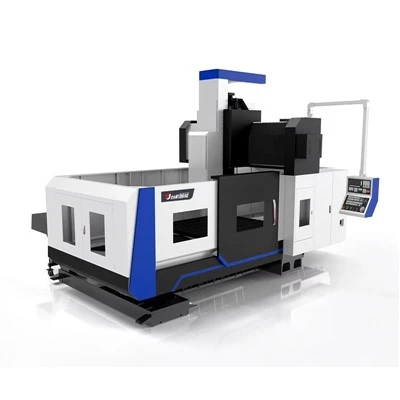
As a supplier of heavy – duty vertical machining centers, I’m here to help you find the perfect machine for your business. Whether you’re a small – scale shop looking for a compact yet powerful machine or a large – scale manufacturer in need of a heavy – duty behemoth, I’ve got a solution for you.
Five Axis Machining Center If you’re interested in learning more about our heavy – duty vertical machining centers or have specific questions about the maximum workpiece size, don’t hesitate to reach out. We can have a detailed discussion about your production requirements and help you choose the right machine that will take your manufacturing process to the next level. Let’s talk about how we can work together to make your machining jobs easier and more efficient.
References
- Manufacturing Technology Handbook, Industrial Press Inc.
- Modern Machining Technology, McGraw – Hill Education
Guangdong Taiji Intelligent Equipment Co., Ltd.
Address: Room 107, Building 15, No. 911 Jian’an Road, Chang’an Town, Dongguan City, Guangdong Province
E-mail: sale@gdtaijicnc.com
WebSite: https://www.gdtaijicnc.com/
