If you’ve ever reached for a bundle of cable ties for an outdoor project—securing garden light fixtures, organizing fence wiring, or fastening signs along a construction site—you’ve probably glanced at the plastic packaging and wondered: are colored nylon cable ties UV-resistant? As a supplier who’s worked with these fasteners for over a decade, I get this question all the time, and it’s one of the most common mistakes I see both DIYers and small business owners make when ordering cable ties: assuming color alone tells you how well a tie will hold up in direct sunlight. Let me break this down clearly, with the science behind the material, the role of color, and what you actually need to look for when picking the right ties for your outdoor space. Colored Nylon Cable Tie
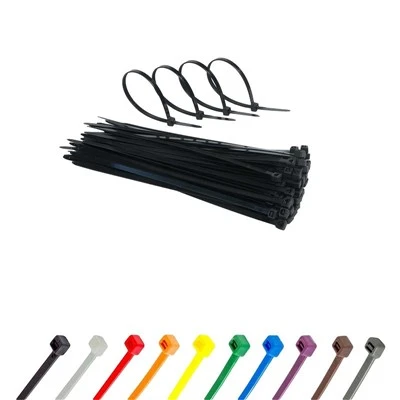
First, let’s start with the basics: nylon, the core material of standard cable ties, is a polyamide thermoplastic. In its natural, uncolored state, nylon 6,6 (the grade we use for most of our colored cable ties) is inherently sensitive to ultraviolet (UV) radiation. When UV rays hit plain nylon, they break down its molecular structure over time—this is called photodegradation. The long polymer chains that give nylon its strength, flexibility, and tensile snap start to split, leaving the tie brittle, discolored, and prone to snapping after just a few weeks of outdoor exposure. For plain, uncolored nylon ties, that process is pretty predictable: most will lose 50% of their tensile strength after about 1,000 to 1,500 hours of continuous UV exposure, per industry testing. That’s roughly 40 to 60 days of full sun in the middle of summer—hardly enough for a long-term outdoor application.
This is where color comes in, but it’s not the most straightforward factor. For years, people assumed darker colors were more UV-resistant, and in some cases, that’s true—but not because the color itself is a shield. UV stabilizers are additives mixed into the nylon during manufacturing, and these stabilizers work by absorbing UV radiation and converting it into harmless heat, or by scavenging the free radicals that form when UV breaks down polymer bonds. When we add color pigments to nylon for our colored cable ties, some pigments can act as UV stabilizers, but others don’t—so not all colored ties are created equal.
For example, black pigment is derived from carbon black, a material with long been used as a UV protectant in plastics. When you add carbon black to nylon, it creates a physical barrier that blocks UV rays from penetrating the plastic, plus it works alongside other chemical stabilizers to slow degradation. That’s why black nylon cable ties are almost always advertised as UV-resistant—and they do perform well: high-quality black nylon ties with proper stabilizer packages can last 5,000 to 10,000 hours of UV exposure, which translates to roughly 14 to 27 months of full sun, and some heavy-duty grades push that even further.
But what about other colors? Red, blue, green, yellow, or white ties—do these hold up? The short answer is: it depends on the pigment and the stabilizers used, not the color. Let’s take bright orange ties, for example. If we add a standard azo pigment for orange, it does not provide any UV protection on its own. If we pair that pigment with the same chemical UV stabilizers we use in black ties, an orange tie will have nearly the same UV resistance as a black one. But if we skip the stabilizers to cut costs, that same orange tie will degrade just as fast as plain nylon, if not faster—some lighter pigments can even be more transparent to UV radiation, letting rays reach the nylon polymer directly and cause faster breakdown.
I see this play out all the time with customers who order blue or green ties for outdoor projects because they match their equipment or landscaping, only to have the ties snap mid-project a few weeks later. Last year, a landscaping contractor came to me after buying a batch of custom green ties for securing outdoor irrigation lines; within two months, half of the ties had turned chalky and broken, leaving pipes sagging and water leaking into flower beds. When I tested those ties in our in-house UV aging chamber, they only lasted 800 hours before dropping to 50% tensile strength—no surprise, since the manufacturer had used a cheap pigment and skipped the stabilizers to lower production costs.
So how can you tell if a colored nylon cable tie is actually UV-resistant, not just colored? It boils down to three key factors, none of which are obvious from looking at the color alone. First, look for a stabilizer package that includes both primary and secondary UV inhibitors. Primary inhibitors absorb UV radiation, while secondary ones repair minor damage to polymer bonds as it forms. Most high-quality colored cable tie suppliers will specify this on product labels, or can provide test data showing 5,000+ hour UV resistance. Second, check the material grade: only nylon 6,6 with a minimum 25% UV stabilizer additive is suitable for outdoor use. Lower-grade nylon 6, or recycled nylon, rarely has enough stabilizer, even in black ties. Third, avoid “custom color” ties that are priced 20% or more below market average—chances are, they cut corners on stabilizers to keep costs low.
A common misconception here is that all outdoor applications need extreme UV resistance. If you’re a homeowner securing Christmas lights for the holiday season, a batch of cheap red ties that will last 3 months is totally fine—you don’t need a 2-year UV rating. But for permanent applications like utility pole wiring, outdoor sign mounting, or marine rigging, UV resistance is non-negotiable. Even in shaded outdoor areas, UV radiation still penetrates cloud cover, and reflective surfaces like concrete or water can bounce UV rays onto ties, so degradation happens slower but still over time.
Another point I want to clarify: UV resistance is different from weather resistance. Some colored nylon cable ties claim to be weather-resistant, but that usually means they can handle extreme temperatures, humidity, or occasional rain—UV resistance is specific to sun exposure. A tie might hold up in a rainstorm for a year, but break in 3 months of direct summer sun. This is a big difference that a lot of suppliers gloss over in marketing, so always ask for specific UV test hours if you’re ordering for outdoor use.
As a colored nylon cable tie supplier, we test every batch of our outdoor-rated colored ties in a QUV chamber, a standard tool in the plastics industry that simulates 10 years of sun exposure in just a few weeks. Our black outdoor ties test at 8,500 hours, while our blue and green outdoor ties—made with the same stabilizer package and UV-stable pigments—test at 7,200 hours, which is still more than enough for a 2-year outdoor project. We also offer custom colored outdoor ties, as long as customers specify that they need UV-stable pigments and stabilizers; we can add these for a small upcharge, since it doesn’t require major changes to our manufacturing process, just a different pigment blend.
What about common alternatives to nylon cable ties for outdoor use, like stainless steel or polyester? While those can offer longer UV resistance, they come with downsides: stainless steel ties are expensive, heavy, and can scratch delicate wiring, while polyester ties are more flexible but also harder to cut and often don’t come in a wide range of colors. Nylon is still the most popular choice for most outdoor projects because it’s lightweight, inexpensive, and available in almost every color, as long as you pick the right grade.
If you’re still unsure whether your colored nylon cable ties will hold up, there’s a simple test you can do at home. Grab a sample tie from your package, mark the length, and leave it in direct sunlight for a month. Then test its tensile strength by pulling it until it breaks—if it snaps at less than half the rated strength printed on the packaging, it’s not UV-resistant, and you’ll need to replace it.
At the end of the day, the question “are colored nylon cable ties UV-resistant?” doesn’t have a yes or no answer. It depends on the stabilizers added during manufacturing, the type of pigment used, and the grade of nylon. Color might be a clue, but it’s not a guarantee—dark colors can be UV-resistant, but light colors can be too, if made with the right additives. Cheap colored ties, no matter how vibrant, will almost always fail outdoors, while higher-quality colored ties engineered for UV resistance will hold up as well as black ones, with the aesthetic benefit of matching your project.
Whether you’re a contractor ordering ties for a large construction project or a DIYer working on a backyard upgrade, picking the right colored nylon cable ties starts with asking the right questions: what’s the UV exposure of my project? What’s the required lifespan? And does the supplier use stabilizers to protect the nylon? If you keep these points in mind, you’ll avoid the frustration of ties snapping mid-project and get fasteners that work as hard as you do, without compromising on color.

If you’re looking for colored nylon cable ties tailored to your outdoor project, or want to learn more about testing and product specifications, get in touch to discuss your needs. We can provide test data, custom color blending, and bulk pricing to fit any project size, from small residential upgrades to large commercial installations.
Colored Nylon Cable Tie References
- “Photodegradation of Nylon 6,6: Mechanisms and Stabilization,” Journal of Applied Polymer Science, Vol. 125, Issue 3, 2012, pp. 1895-1903
- “UV Stabilization of Colored Thermoplastics,” Plastics Additives Handbook, 6th Edition, Hanser Publications, 2015
- QUV Accelerated Weather Testing Standards, ASTM G154-16, Standard Practice for Operating Fluorescent Ultraviolet (UV) Lamp Apparatus for Exposure of Nonmetallic Materials
Wenzhou Xinsheng Co., Ltd.
Wenzhou Xinsheng Co., Ltd. is one of the most professional colored nylon cable tie manufacturers and suppliers in China. We have world-leading production equipment and strong manufacturing capabilities. If you’re going to wholesale bulk durable colored nylon cable tie made in China, welcome to get pricelist from our factory. For price consultation, contact us.
Address: No.419, Gongye Huanlu, Dongmeng Industrial Zone, Wuniu Street, Yongjia County, Wenzhou City, Zhejiang Province, China
E-mail: xuenda1@gmail.com
WebSite: https://www.wenzhouxinsheng.com/
