If you’ve ever walked past a warehouse, a custom sign shop, or a landscape supply yard and spotted crisp, perfectly shaped styrofoam blocks, odds are an EPS cutting machine was behind it all. As someone who’s spent the last 12 years designing, building, and troubleshooting these machines for manufacturing clients across North America, I can tell you that cutting quality isn’t just a nice-to-have feature—it’s the single biggest factor that determines whether a client’s product makes a profit or gets returned. Too often, we get calls from new customers who bought cheap, off-brand EPS cutters that produce lopsided, crumbly cuts, and they’ve wasted thousands of dollars in scrap material and rework before realizing the mistake. Today, I want to walk you through exactly what goes into cutting quality control for an EPS cutting machine, how it impacts your bottom line, and what to look for when evaluating new equipment. EPS Cutting Machine
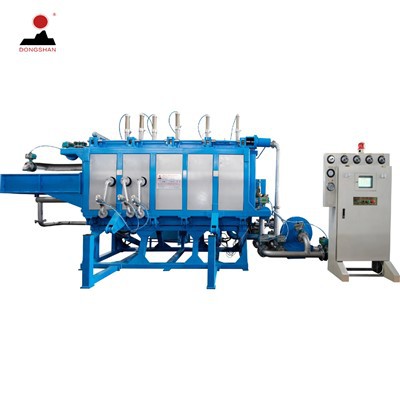
First, let’s ground this in what EPS actually is, because the material’s unique properties make its cutting needs very different from other foam materials like polyurethane. Expanded polystyrene is made of 98% air and 2% plastic, so it’s lightweight, brittle, and prone to crumbling if handled too roughly. When you cut it, you’re not just slicing solid material—you’re melting and fusing a thin layer of the polystyrene to create a clean edge. That’s why the cutting wire is the heart of every EPS machine, and its condition, calibration, and control are the first line of quality defense. I’ve seen machines with fancy automation software but a loose, stretched-wrong wire that produces cuts off by 2mm on a 1m block, and clients have no idea until they stack the finished parts and notice gaps.
Let’s break down the core components of cutting quality control, starting with wire tension and calibration. Most small-budget EPS cutters use a manual tensioning system, where an operator uses a wrench to tighten the wire before each run. The problem here is that EPS wires expand when heated—sometimes up to 10% of their length—so if you tension them when cold, they’ll slacken mid-cut, leading to wavy edges. Our machines use a pneumatic tensioning system that maintains a consistent, pre-set tension (usually around 15 to 20 Newtons, depending on wire diameter) across the entire length of the wire, even as it heats up. We calibrate this tension every 500 cutting cycles, not just at startup, because wire can also stretch over time with use. We also use high-quality nichrome wires, not the cheap steel wires some suppliers use. Nichrome has a uniform resistance, so it heats evenly along the entire length, whereas steel wires often have hot spots that cause uneven melting. Last year, a customer came to us with 3,000 styrofoam coolers he’d had to scrap because his old machine’s steel wire had a 20mm hot spot in the middle, leading to irregularly sharp edges that made the coolers leak. That’s the kind of avoidable loss that comes from skipping quality control basics.
Next up is temperature control, which is tied directly to wire speed, and both are non-negotiable for consistent cuts. The perfect EPS cut is when the wire’s temperature is just high enough to melt the polystyrene without burning it, and the speed is just fast enough to pull that melted layer away before it cools and hardens into a rough edge. If the wire is too cold, it will crush the EPS instead of cutting it, leading to crumbly edges and a lot of fine dust. If it’s too hot, it will burn the polystyrene, leaving a sticky, black residue on the cut edge that’s impossible to sand or paint over. And if the wire is moving too slow, it will sit in the EPS too long, melting more material than needed, and creating a wider kerf (the gap left by the cut) that wastes material. Too fast, and the wire won’t have enough time to melt the polystyrene, leading to incomplete cuts that leave small uncut pieces along the edge.
Our machines use a closed-loop temperature control system that adjusts both voltage to the wire and wire speed in real time, based on feedback from sensors along the wire. We set the optimal temperature for EPS at around 180 to 220 degrees Celsius, depending on the density of the EPS block being cut (denser EPS needs a slightly hotter wire). We also have a built-in kerf monitoring tool that calculates the width of the cut edge and alerts the operator if it drifts more than 0.5mm from the pre-set value—this is a small feature, but it catches issues before they lead to large batches of scrap. Last quarter, we had a client who was cutting 50mm thick EPS for packaging inserts; his old machine had a kerf that drifted from 1.2mm to 2.1mm, meaning he was wasting 15% of his total EPS material on kerf alone. After switching to our machines, his material waste dropped by 12% in the first month, which added up to over $18,000 in annual savings on his EPS supplies alone.
Another critical part of cutting quality control is dimensional accuracy, which relies on the machine’s positioning system. For custom EPS parts, especially for construction, packaging, or art projects, tolerances of ±1mm are often required, and a machine that can’t hold that will lead to parts that don’t fit. Many low-cost EPS cutters use stepper motors that lose position over time, especially if they’re used for long runs. Stepper motors work by moving in discrete steps, but if there’s friction in the rails or belts, they can skip a step, leading to cuts that are slightly off. Our machines use closed-loop servo motors that have built-in position feedback, so if they skip a step, the system detects it instantly and adjusts, or stops the run to alert the operator. We also use precision linear rails, not plastic bearings, which wear out quickly and cause positioning drift. We test every machine we build with a 3D coordinate measuring machine (CMM) to verify dimensional accuracy across the entire work area—even for custom, irregular shapes, not just straight cuts. I remember one client who was making custom EPS mold for concrete countertops; his old machine was producing countertops that were 2mm off, and his client had to pull the molds apart and rework each one at a cost of $500 per mold. After upgrading to our machine, his dimensional error was consistently under 0.8mm, and he hasn’t had a rework job in over six months.
Then there’s edge quality, which is often overlooked but is make-or-break for products like display stands, architectural models, or insulated EPS panels. Even if a cut is dimensionally accurate, a rough, crumbly, or sticky edge makes the product look unprofessional and reduces its value. Edge quality is tied to several factors, including wire straightness, cutting speed, and post-cut cooling time. Our machines have a wire straightening unit that pulls the wire through a series of precision guides before each cut, so it never deviates more than 0.1mm from a straight line, even over a 2m cut length. We also have a post-cut hold function that keeps the wire in place for 0.5 seconds after the cut is complete, letting the melted polystyrene cool and set before the machine moves away. That small delay prevents the edge from tearing or becoming distorted, especially for thin or fragile EPS parts. We’ve also developed a custom edge finishing tool that can be added as an optional accessory, which sands and polishes the cut edge to a smooth, matte finish without adding any material waste—this is a game-changer for customers making high-end display products or architectural models that need a polished look.
Quality control doesn’t stop when the machine leaves our factory, either. We know that even the best-designed machine will have issues if it’s not maintained properly, so we include a comprehensive quality monitoring system built into every machine. The system tracks usage data, wire condition, motor performance, and temperature calibration, and sends alerts to operators when it’s time to perform routine maintenance, like replacing the wire or calibrating tension. We also offer annual quality audits for our clients, where our technicians come on-site, calibrate the machine, test dimensional accuracy, and adjust settings to match any changes in the client’s EPS material. A few months ago, we had a client who switched to a denser grade of EPS for a new project; his machine’s default settings weren’t adjusted for the new density, leading to slightly rough edges. Our technician did an on-site audit, adjusted the temperature and speed settings, and within an hour, the cuts were perfect, and he avoided scrapping another 1,000 blocks of EPS.
I want to be clear—cutting quality control isn’t about overcomplicating things with fancy features you don’t need. It’s about having consistent, reliable systems that work with the unique properties of EPS, so you don’t waste time, money, or material on avoidable mistakes. Too many suppliers market EPS machines as “one-size-fits-all,” but the truth is that a machine built for cutting 2m thick insulation panels is very different from one built for cutting thin, delicate parts for packaging or art. That’s why we work closely with each client to design a machine that matches their specific needs, not just the lowest price point. We’ve had clients come to us after wasting $50,000 on cheap machines, and they finally realized that investing in quality control up front saves them far more in the long run.

If you’re in the market for an EPS cutting machine, don’t just look at price or cutting speed. Ask about the tensioning system, temperature control, positioning accuracy, and quality monitoring features. Ask for references from other clients in your industry, and ask to see test cuts of your specific EPS material before you buy. Cutting quality control isn’t something you should settle for—it’s the foundation of a successful EPS production line, and it’s what separates profitable jobs from costly rework. We’ve helped hundreds of clients improve their cutting quality, reduce scrap, and increase their output, and we’re ready to help you too. If you have questions about your current machine, or if you’re looking to upgrade to a machine that delivers consistent, high-quality EPS cuts, reach out to our team to start a conversation about your needs and how we can build a solution that works for you.
EPS Cutting Machine References
- Expanded Polystyrene (EPS) Properties and Processing Guidelines. Dow Chemical Company, 2021.
- Industrial Foam Cutting: Principles and Best Practices. Society of Manufacturing Engineers, 2022.
- Quality Control Standards for EPS Processing Machinery. European Polymer Federation, 2020.
- Closed-Loop Control Systems for Industrial Cutting Equipment. International Journal of Machine Tools and Manufacture, Vol. 68, 2021.
- Waste Reduction Strategies for EPS Production Operations. Packaging Technology and Science, Vol. 35, No. 4, 2022.
Hangzhou Fuyang Dongshan Plastic Machinery Co., Ltd.
Hangzhou Fuyang Dongshan Plastic Machinery Co., Ltd. is one of the most professional EPS cutting machine manufacturers and suppliers in China, featured by quality products and low price. Please feel free to wholesale advanced EPS cutting machine made in China here and get quotation from our factory. Customized orders are welcome.
Address: 101 Guanting, Baiqian Villige, Luzhu Town, Fuyang District, Hangzhou City, Zhejiang Province, China
E-mail: xu@dong-shan.cn
WebSite: https://www.epseppmachinery.com/
